
How to Spot a Clogged Dryer Vent: 8 Warning Signs
Most homeowners do not think about their dryer vent until something goes wrong. The dryer runs, the clothes come out, and that feels like enough. But behind that routine is a vent system that collects lint with every single cycle, and over time, that buildup becomes one of the most underestimated fire hazards in a residential home.
The U.S. Fire Administration reports that dryers and washing machines cause an estimated 2,900 home fires each year, with the leading cause being failure to clean the dryer vent. In California, where homes run dryers year-round and many properties have long or complex vent runs, the risk is real and consistent.
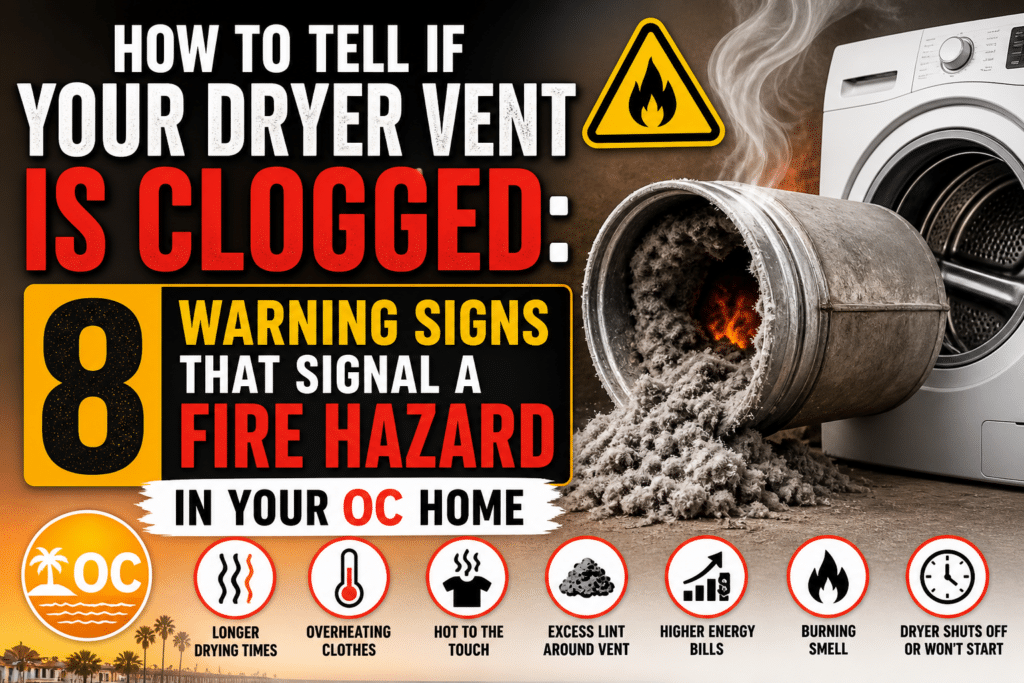
The good news is that a clogged dryer vent almost always gives you warning before it becomes a crisis. Here are eight signs that your dryer vent needs immediate attention.
How Do I Know If My Dryer Vent Is Clogged?
The most reliable way to know is to pay attention to how your dryer is actually performing, because a restricted vent changes the way your machine behaves in ways you can observe without any special equipment.
The eight warning signs below cover the full range of symptoms, from the ones most homeowners notice first to the ones that tend to get ignored until something goes seriously wrong. If you recognize more than one of these in your home, that is not a coincidence. It is your vent system telling you something.
Warning Sign 1: Clothes Are Taking More Than One Cycle to Dry
This is the most common first symptom and the one that gets dismissed most often. A dryer that used to finish a load in 45 minutes now takes 70, or you pull laundry out still damp and run it again without thinking much of it.
What is actually happening is that your dryer relies on airflow to push hot, moisture-laden air out through the vent. When that vent is partially or fully blocked, the humid air has nowhere to go. It stays inside the drum, your clothes stay wet, and your dryer keeps running longer and longer trying to compensate.
If your drying times have crept up over the past several months, a clogged vent is the most likely explanation.
Warning Sign 2: The Dryer or Clothes Feel Unusually Hot After a Cycle
Pull your clothes out after a normal cycle. If they feel extremely hot to the touch, hotter than they used to, that is a problem worth taking seriously.
The same goes for the dryer itself. Run your hand along the outside of the machine after a cycle. If the exterior feels hot rather than just warm, or if the laundry room feels noticeably warmer than the rest of the house after the dryer runs, heat is being trapped inside the system instead of venting out.
This happens because restricted airflow forces heat to build up inside the dryer drum and the vent line. That heat has to go somewhere, and when it cannot escape through a clear vent, it radiates outward. A dryer running this hot is working harder than it should and creating conditions that are closer to a fire risk than most homeowners realize.
Warning Sign 3: You Notice a Burning Smell During or After a Cycle
This one should stop you immediately.
A burning smell coming from your dryer is almost always lint. Lint is highly flammable, and when it accumulates near the heating element or inside a restricted vent line, the heat generated by normal dryer operation is sometimes enough to scorch it. That scorching smell is a warning that you are very close to an ignition event.
Do not run the dryer again until the vent has been inspected and cleared. This is not a wait-and-see situation.
Warning Sign 4: The Exterior Vent Flap Is Not Opening When the Dryer Runs
Walk outside to where your dryer vents to the exterior of your home. It should have a flap or damper that opens when the dryer is running and closes when it is not. This flap is pushed open by the airflow moving through the vent.
Run your dryer and check that flap. If it is barely moving, only partially open, or not moving at all, your vent does not have enough airflow pushing through it. That means the vent is blocked somewhere between the dryer and the exterior wall.
This is one of the easiest checks a homeowner can do and one of the most informative. A fully clear vent produces a noticeable push of warm air at the exterior cap. Anything less than that points to a restriction.
Warning Sign 5: Lint Is Accumulating Around the Dryer or Vent Opening
Your lint trap catches a significant portion of lint produced during a drying cycle, but it does not catch all of it. Some always makes it past the trap and into the vent line. In a clear, properly functioning vent, that lint gets pushed all the way out to the exterior.
When the vent is clogged, lint has nowhere to go. It starts backing up. You may notice it collecting around the back of the dryer, around the connection point where the flexible duct meets the wall, or even coming out around the lint trap housing itself.
If you are finding lint in places it should not be, the vent is telling you it is full.
Warning Sign 6: It Has Been More Than a Year Since the Vent Was Cleaned
This one is less about symptoms you can see and more about honest math.
The National Fire Protection Association (NFPA) recommends that dryer vents be inspected and cleaned at least once per year for a typical household. Homes with large families doing multiple loads per week, or homes with long vent runs common in OC two-story houses, may need it more often.
If you cannot remember the last time your dryer vent was professionally cleaned, or if you have never had it done since moving in, the vent almost certainly has significant lint buildup regardless of whether you have noticed symptoms yet. Annual cleaning is not an upsell. It is standard maintenance with a direct connection to fire prevention.
Warning Sign 7: The Laundry Room Is More Humid Than It Should Be
A properly vented dryer pushes moisture out of the house. A clogged or poorly venting dryer pushes some of that moisture back into the room instead.
If your laundry room feels humid or steamy after a drying cycle, or if you notice condensation forming on nearby surfaces like windows or walls, moisture is not escaping the way it should. Over time, that excess humidity creates secondary problems including mold growth in the laundry room itself.
In Orange County, where indoor humidity is generally low, a damp-feeling laundry room after a dryer cycle is a clear red flag.
Warning Sign 8: Your Dryer Is Shutting Off Before the Cycle Finishes
Modern dryers are equipped with a thermal safety device called a thermal fuse. Its job is to shut the dryer down if internal temperatures get too high, protecting against fire. If your dryer stops mid-cycle and will not restart until it cools down, the thermal fuse is doing exactly what it was designed to do.
This is not a dryer malfunction. It is a safety response to a ventilation problem. Running the dryer again without addressing the underlying clog will keep tripping the thermal fuse, and eventually the fuse itself will blow permanently, requiring a repair. More importantly, it means your dryer is consistently reaching temperatures high enough to trigger a safety shutoff, which is a fire risk condition.
What Happens If You Never Clean Your Dryer Vent?
The short answer is that the risk compounds over time.
In the early stages, a partially clogged vent costs you efficiency. Longer drying times mean more electricity used per load, and a dryer working harder than necessary wears out sooner. The Consumer Product Safety Commission (CPSC) estimates that dryer fires cause approximately 35 deaths, 90 injuries, and $84 million in property damage annually in the United States.
As the blockage worsens, heat and lint reach the combination that causes ignition. Lint is one of the most combustible materials found in a home, and a dryer vent that has not been cleaned in several years can contain a dense, compressed mass of it running the full length of the duct line. It does not take a dramatic malfunction to ignite that material. Normal dryer operating temperatures are sometimes sufficient.
How Many House Fires in California Are Caused by Clogged Dryer Vents Each Year?
California consistently ranks among the states with the highest number of dryer-related fires, driven by high housing density, year-round dryer use, and a large share of older housing stock with long or outdated vent configurations.
The NFPA data shows that dryers are involved in one of every 22 home fires reported to fire departments. In California specifically, the combination of dry conditions, homes built before modern venting standards, and the prevalence of long vent runs in two-story and multi-unit properties creates conditions where dryer vent fires occur with regularity.
Orange County homes are not exempt from this. Many properties in OC were built in the 1970s and 1980s with vent configurations that do not meet current standards and that have never been updated. If your home falls into that category, an inspection is overdue.
Can a Clogged Dryer Vent Cause Carbon Monoxide Poisoning?
This applies specifically to gas dryers, and the answer is yes.
Gas dryers produce carbon monoxide as a byproduct of combustion. Under normal operation, that carbon monoxide exits the home through the dryer vent along with heat and moisture. When the vent is blocked, carbon monoxide can back up into the laundry room and spread through the home.
Carbon monoxide is odorless and colorless, which makes it especially dangerous. Symptoms of exposure include headache, dizziness, nausea, and confusion, all of which can be mistaken for other conditions. If multiple people in the household experience these symptoms simultaneously, particularly when the dryer has been running, do not wait. Get everyone out of the home and call emergency services.
If you have a gas dryer, a working carbon monoxide detector in or near the laundry room is not optional. And a clogged vent on a gas dryer is a more urgent situation than on an electric unit.
Does a Clogged Dryer Vent Make Clothes Take Longer to Dry?
Yes, and this is typically the first symptom homeowners notice, often well before any of the more serious warning signs appear.
When airflow through the vent is restricted, the dryer cannot move moisture out of the drum efficiently. The air inside the drum becomes saturated with moisture early in the cycle and stays that way. Clothes take longer to dry, come out feeling slightly damp, or require a second cycle to finish completely.
If you have noticed this happening gradually over several months rather than all at once, that pattern is consistent with a vent that has been accumulating lint steadily over time. The blockage does not happen overnight, and neither does the decline in drying performance.
What to Do If You Recognize These Signs
Do not keep running the dryer and hope the problem resolves on its own. A clogged dryer vent does not clear itself.
The right move is to schedule a professional dryer vent inspection. A technician will run the full length of the vent, identify where buildup has accumulated, and clear it using equipment designed for the job. For homes with longer vent runs or vents that exit through the roof rather than a side wall, professional cleaning is the only reliable option.
Dr. Dryer Vent and Air Duct Cleaning serves Orange County homeowners with thorough dryer vent inspections and professional cleaning. If you have noticed any of the warning signs above, or if you simply cannot remember the last time your vent was serviced, reach out to schedule an inspection. It is one of the most straightforward fire prevention steps available to a homeowner, and it takes less time than you might expect.