Air Duct Cleaning: Does It Improve Air Quality?
If you have ever noticed a thin layer of dust settling back onto your furniture hours after cleaning, or found yourself sneezing more than usual inside your own home, your air ducts have probably crossed your mind at some point. Maybe a neighbor mentioned getting theirs cleaned, or you have seen service company ads promising fresher air and lower energy bills. But the question most Orange County homeowners are actually sitting with is simpler than all of that: does air duct cleaning do anything real, or is it just a service people sell to worried homeowners who do not know any better?
This guide gives you a straight answer. No scare tactics, no overselling. Just what air duct cleaning is, what it actually does, when it genuinely makes sense for your home, and when it does not.
Is Air Duct Cleaning Actually Worth It?
The honest answer is that it depends entirely on what is going on inside your specific duct system.
The U.S. Environmental Protection Agency has a deliberately measured stance on this topic. Their indoor air quality guidelines acknowledge that duct cleaning has not been proven to prevent health problems in every household situation, and they stop short of recommending it as routine maintenance for all homes. On the surface, that might sound like a reason to skip it entirely. But their guidance goes further, and the full picture is more nuanced than that one sentence suggests.
The EPA also states clearly that cleaning is appropriate in specific situations: when there is visible mold growth inside ducts or on HVAC system components, when ducts are infested with rodents or insects, or when ducts are clogged with excessive debris that is actively being released into the living space. Their position is not that duct cleaning is useless. It is that cleaning should be based on what is actually present in the system, not on a blanket schedule applied to every home regardless of conditions.
So the more useful question is not whether air duct cleaning works in the abstract. It is whether your home, right now, is one of the situations where it is warranted.
For many Orange County homeowners, the answer leans toward yes, and for reasons specific to this region. The dry climate, the seasonal Santa Ana winds that push fine particles into homes from outside, and the wildfire smoke that moves through Southern California during fire season all introduce particulate matter into homes in ways that simply do not apply in other parts of the country. If your home has been through several fire seasons without a duct inspection, there is a reasonable chance your system is holding onto more than just ordinary household dust.
What Do Air Duct Cleaners Remove from Your Ducts?
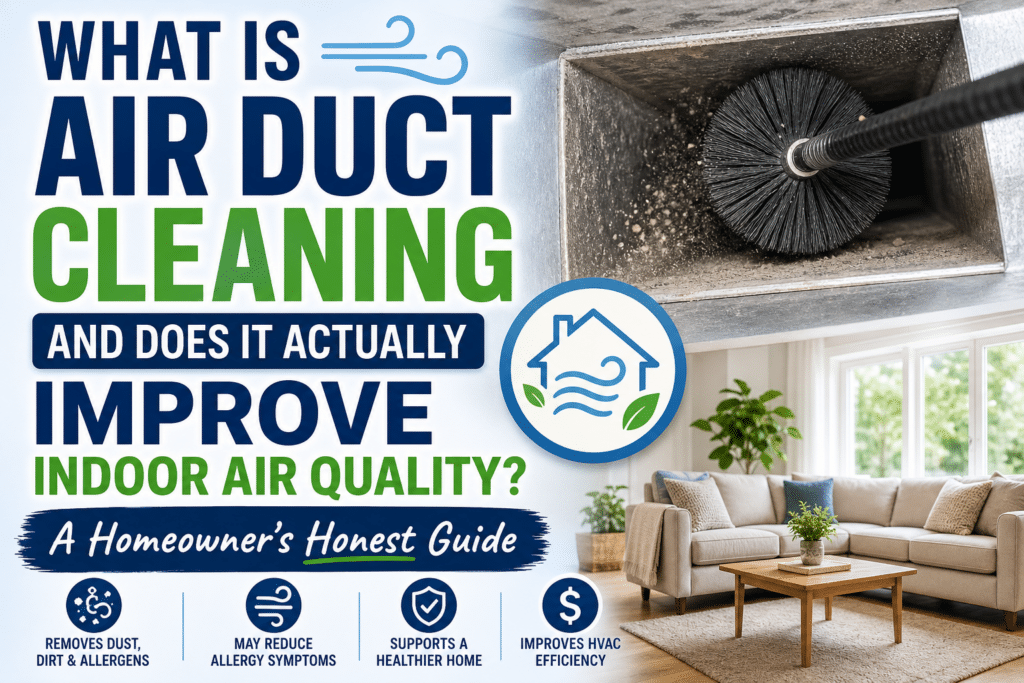
When a professional air duct cleaning company arrives at your home, they are not simply running a household vacuum through your vents. A thorough job involves accessing the full duct system from multiple points, using specialized agitation equipment to dislodge buildup from the duct walls, and capturing everything that gets loosened before it can circulate back through your living space. The process is more involved than most homeowners expect, and so is the list of what comes out.
Accumulated dust and debris is the most common finding and the one that builds up in every home over time regardless of how well-maintained the property is. Over years of daily HVAC operation, dust settles into the interior walls of ducts, collects around bends and at register openings, and compresses into a coating that your air filter was never designed to catch after the fact.
Pet dander and hair is a significant factor in homes with dogs and cats. Dander accumulates at a rate that surprises most pet owners. It travels past return air vents and coats the interior of duct runs over time, getting recirculated through the home with every heating and cooling cycle.
Mold spores are a concern specific to certain home conditions. Orange County summers are warm, and depending on your home’s humidity levels and the condition of the insulation around your ductwork, the interior environment near the air handler can develop enough moisture to support mold growth. Mold spores circulating through an HVAC system are a genuine indoor air quality concern, not a theoretical one.
Wildfire ash and smoke residue is a Southern California-specific issue that sets OC homes apart from homes in most other regions. During fire season, fine particulate matter from smoke enters homes through gaps around windows, doors, and the HVAC system itself. It settles inside ductwork and lingers long after the air outside has returned to normal. Homeowners who ran their HVAC systems during regional fire events may have more smoke residue in their ducts than they realize.
Rodent droppings and nesting material are an unpleasant but genuinely common finding, particularly in older homes or properties surrounded by dry brush. Rodents find their way into ductwork through exterior gaps and gaps around pipe penetrations. If this has happened in your home, cleaning is not a matter of preference. It is a health necessity.
Construction dust is worth flagging separately for anyone who has done remodeling in the past few years. Fine particles from drywall cutting, sanding, demolition, and finish work travel through the air and into HVAC returns during construction. That dust settles inside duct lines and stays there. A standard post-renovation cleaning of visible surfaces does not address what made it into the system.
How Often Should Air Ducts Be Cleaned in Orange County?
The general industry guidance recommends having your ducts inspected every three to five years, with cleaning performed based on what the inspection reveals rather than on a fixed calendar. That range is a reasonable starting point for an average household in an average climate, but Orange County is not an average climate, and several local factors push many homeowners toward the shorter end of that window.
Fire season exposure is the most significant regional factor. If your home was in the path of smoke during recent wildfire events, particularly if you were running your HVAC system during that period, a cleaning sooner than the standard interval is worth considering. Smoke particulate is fine enough to bypass most residential filters and settle deep inside ductwork where it stays until it is physically removed.
Pet ownership matters more than many homeowners account for. Homes with multiple pets, or with heavy-shedding breeds, accumulate dander and hair in duct systems faster than the standard three-to-five-year guideline assumes. A home with three large dogs may need an inspection every two years rather than every four.
Recent construction or renovation is a straightforward trigger for an inspection regardless of your normal schedule. Any significant remodeling work that involved drywall, demolition, or sanding in rooms served by your HVAC system is a reasonable reason to have the ducts checked.
Increased respiratory symptoms with no identified cause should prompt an inspection if other sources have been ruled out. If household members are experiencing more frequent allergy flare-ups, headaches, or respiratory irritation indoors, and no other explanation has been found, the duct system is a logical next step to investigate.
Moving into a previously owned home is something many buyers overlook in the process of settling in. When you purchase a home, you inherit whatever the previous owners left behind in the ductwork, and maintenance records for duct cleaning are rarely included in a home disclosure. An inspection in the first year of ownership is a straightforward way to establish a baseline and identify anything that needs attention.
Does Air Duct Cleaning Help with Allergies and Asthma?
This is where it is important to be direct with you rather than lean on vague reassurances.
Air duct cleaning alone is not a treatment for allergies or asthma. It will not eliminate allergens from your home entirely, and it should never be presented as a medical intervention. That said, for households where the duct system is genuinely contributing to poor indoor air quality, cleaning addresses one real source of recirculated irritants, and that can produce a noticeable difference in day-to-day comfort.
The EPA identifies indoor air pollution as one of the top five environmental health risks. Americans spend roughly 90 percent of their time indoors, and indoor air can carry two to five times the concentration of certain pollutants compared to outdoor air. Dust mite debris, mold spores, pet dander, and pollen particles that get pulled into the HVAC return and recirculated through dirty ductwork are genuine allergens that affect real people in real homes.
For a household where allergy or asthma symptoms are consistently worse indoors than outdoors, or noticeably worse in certain rooms, contaminated ductwork is a legitimate suspect. Cleaning in those situations often produces a measurable improvement in symptoms, particularly when combined with regular filter changes, maintained humidity levels, and clean return vents. It works best as one part of a broader approach to indoor air quality rather than a standalone solution.
What cleaning will not do is solve an active moisture problem, stop a mold source that is still growing, or substitute for proper HVAC maintenance. If mold is the underlying issue, the source needs to be identified and addressed at the same time as the duct cleaning. Cleaning ducts without resolving the conditions that allowed mold to develop means the problem will return.
What Is the Difference Between Air Duct Cleaning and HVAC Cleaning?
These two terms are used interchangeably in a lot of service company marketing, but they refer to meaningfully different scopes of work. Understanding the distinction helps you ask the right questions when you are getting quotes and ensures you know what you are actually paying for.
Air duct cleaning focuses specifically on the ductwork itself. That is the network of channels, both supply and return, that carries conditioned air from your HVAC unit to every room in your home and back again. A duct cleaning job involves accessing those channels at multiple points, using agitation tools to loosen buildup from interior duct walls, and removing the dislodged material through a high-powered collection system before it can re-enter the living space.
HVAC cleaning is a broader term that extends to the mechanical components of your heating and cooling system. This includes the evaporator coils, the blower motor and housing, the drain pan, the air handler cabinet, and in some cases the furnace heat exchanger. These components accumulate dirt and biological growth independently of the ductwork, and a heavily fouled evaporator coil or clogged blower reduces system efficiency while also becoming a source of contamination that feeds back into the ducts.
For homeowners who have not had either service performed in several years, a combined approach makes the most practical sense. Cleaning the ductwork thoroughly without addressing a fouled evaporator coil is similar to cleaning the pipes in your kitchen while leaving residue in the faucet head. The duct system stays cleaner longer when the components feeding conditioned air into it are clean as well.
When contacting a service provider, ask specifically what their scope covers. A reputable company will walk you through exactly which components they access, what equipment they use, and how they verify the work is complete. Asking to see before-and-after photos or video inspection footage is a reasonable request that any professional service should be able to accommodate.
Can Dirty Air Ducts Make You Sick?
They can contribute to symptoms, yes, though the relationship between duct contamination and specific health outcomes is not always straightforward or immediate.
Dirty air ducts do not cause illness the way a pathogen does. What they do is introduce and continuously recirculate irritants and, in more serious cases, biological contaminants throughout your home every time the HVAC system cycles on. Over months and years of daily exposure, that accumulation can produce real and consistent effects.
Common complaints associated with poor indoor air quality from contaminated ductwork include persistent headaches, particularly upon waking or after extended time spent indoors. Fatigue that does not improve with adequate rest is another frequently reported pattern. Respiratory irritation including a chronic mild cough, recurring runny nose, or persistent scratchy throat that clears up noticeably when the person spends time outside or away from home is a signal worth investigating. Eye irritation and skin sensitivity can also point in this direction, particularly in households with known sensitivities.
None of these symptoms on their own are proof that duct contamination is the source. Indoor air quality is affected by many factors, and a proper investigation rules out other causes before landing on the duct system. But they are a reasonable prompt to schedule an inspection, and an experienced technician can quickly tell you whether what they find inside your system is significant enough to be a concern.
The more serious scenarios involve confirmed mold growth inside the ductwork or evidence of rodent activity. Both of these conditions have more direct effects on respiratory health and should be addressed promptly rather than monitored. If a musty odor is consistently present when the HVAC system runs, or if occupants experience symptoms that track closely with system operation times, those are specific signals that warrant an inspection without delay.
The Bottom Line for Orange County Homeowners
Air duct cleaning is not a universal fix, and any company that guarantees dramatic health improvements without first inspecting your system is not approaching this work honestly. But it is also not the blanket scam that some skeptics describe. When your ducts are carrying years of accumulated debris, wildfire residue, pet dander, mold spores, or other contaminants, professional cleaning is a practical and well-supported step toward a healthier indoor environment.
The right place to start is always an inspection. A trained technician can look inside your system, show you what is actually present, and give you an honest recommendation based on conditions rather than a sales script. If your ducts are in reasonable shape, a reputable company will tell you that too and save you the cost of an unnecessary cleaning.
If you are in Orange County and want a clear picture of what is inside your duct system, Dr. Dryer Vent and Air Duct Cleaning offers thorough inspections and professional cleaning using equipment designed to handle the full scope of residential ductwork. Reach out to schedule an inspection and get an honest assessment of where your indoor air quality actually stands.